马上注册,阅读更多内容,享用更多功能!
您需要 登录 才可以下载或查看,没有账号?立即注册 
×
Survival and Outcomes after Nonoperative Management of Operable Non Small Cell Lung Cancer
Objective:
The outcomes of operable non–small cell lung cancer (NSCLC) patients who forgo surgery remain poorly defined in the era of modern systemic and radiation therapies. This study evaluated the survival of untreated operable NSCLC compared with non-surgically treated patients using contemporary data.
Methods:
Using the National Cancer Database (2018–2022), we identified patients with clinical stage I–IIIB NSCLC considered operable. Patients were classified as untreated, treated non-operatively (SBRT, RT, chemotherapy, immunotherapy, or combinations), or surgically treated with/without perioperative therapy. Baseline characteristics and overall survival (OS) were compared using chi-square, t-tests, Kaplan–Meier, and Cox regression analyses.
Results:
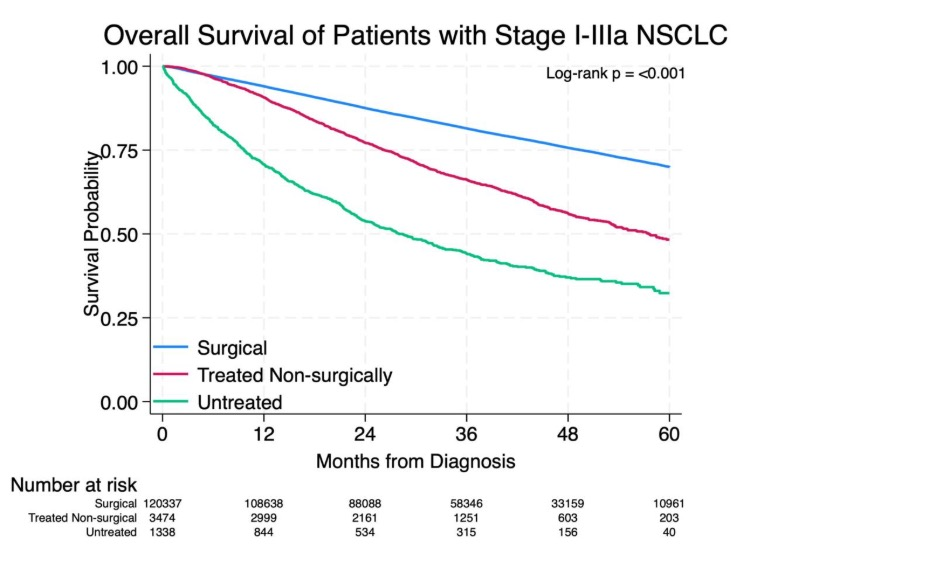
Among 155,693 operable patients, 149,686 (96%) underwent surgery, 4,373 (3%) received non-operative treatment, and 1,634 (1%) were untreated. Untreated patients were younger (72.3 vs 73.2 years, p=0.0015), more often White (79% vs 86%, p<0.001), and more frequently treated at academic centers (29% vs 24%, p<0.001). Median OS for untreated vs treated non-operatively patients was 45 vs 64 months for stage I, 16 vs 37 months for stage II, and 9 vs 40 months for stage III disease. Five-year survival was 43%, 17%, and 14% for untreated vs 53%, 34%, and 40% for non-operatively treated patients, respectively.
Among stage IIIB patients, median survival was 9 months untreated vs 33 months with nonsurgical therapy (p<0.001). On multivariable analysis, increasing age (HR 1.04, 95% CI 1.01–1.07, p=0.02), squamous histology (HR 2.24, 95% CI 1.22–4.10, p=0.01), and certain facility locations were independently associated with survival differences.
Conclusions:
Operable NSCLC patients who undergo surgical treatment achieve the most favorable survival outcomes. Those treated non-operatively in the modern era of precision oncology also experience a meaningful survival advantage. In contrast, untreated operable NSCLC remains associated with poor prognosis, with median survival under one year for stage III disease. These findings highlight the critical importance of offering active treatment-surgical or nonsurgical-whenever feasible.
Raffaele Rocco (1), Ralf Martz Sulague (2), Vikram Krishna (2), Philicia Moonsamy (3), Andrew Brownlee (2), Harmik Soukiasian (2), (1) Cedars Sinai Medical Center, Los Angeles, CA, (2) Cedars-Sinai Medical Center, Los Angeles, CA, (3) N/A, Los Angeles, CA
|