马上注册,阅读更多内容,享用更多功能!
您需要 登录 才可以下载或查看,没有账号?立即注册 
×
Metabolic Reprogramming of Early Lung Adenocarcinoma Enables Targeted Optical Imaging with Novel SGLT2-Targeted Near-Infrared Tracer
生物光学成像(Optical Imaging)
钠-葡萄糖协同转运蛋白2(sodium-glucose cotransporter 2,SGLT2)
Objectives: Lung adenocarcinoma (LUAD) is increasingly detected at early stages, yet small and subsolid lesions remain difficult to localize and resect. Positron emission tomography (PET) often fails to detect these tumors, a limitation attributed to presumed metabolic inactivity. We hypothesized that early LUADs are metabolically active but use an alternative glucose transport pathway mediated by sodium-glucose cotransporter 2 (SGLT2) rather than glucose transporter 1 (GLUT1). This study examines glycolytic activity and glucose transporter expression across the LUAD spectrum and evaluates an SGLT2-targeted near-infrared (NIR) probe, GlucoGlo, for intraoperative molecular imaging (IMI) of early LUAD.
Methods: SGLT2, GLUT1, and lactate dehydrogenase (LDH) expression were analyzed by immunohistochemistry and mRNA expression database in human LUAD, normal lung, and inflammatory lung lesions. Based on these findings, the NIR probe GlucoGlo was developed and assessed for SGLT2-targeting in vitro, in murine xenografts, and in ex vivo precision cut lung slices (PCLS) of patients undergoing LUAD resection. In vitro competitive inhibition with glucose and unlabeled ligand and in vivo SGLT2 blockade were used to confirm target specificity.
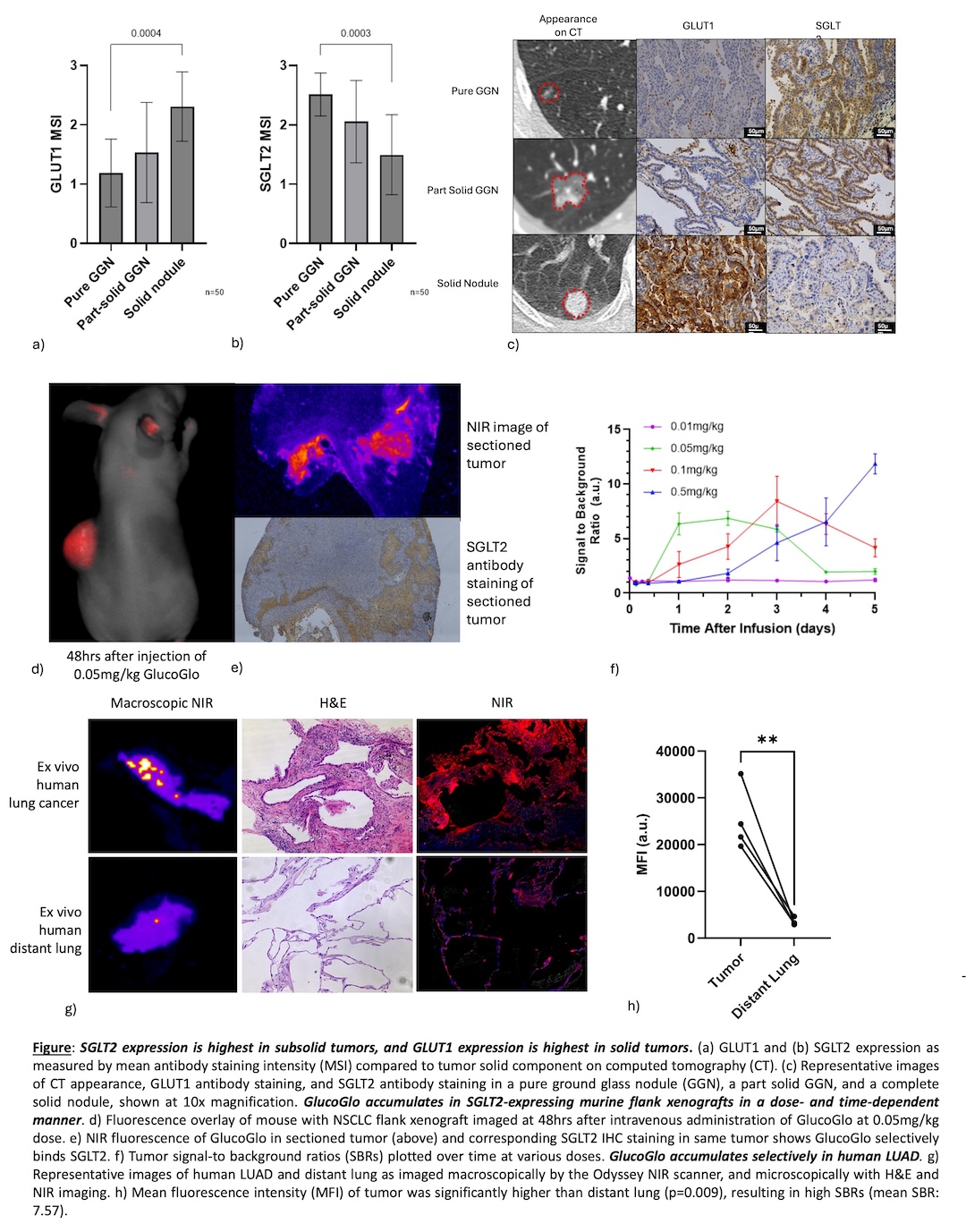
Results: High LDH expression confirmed elevated glycolytic activity in preinvasive and minimally invasive LUAD compared to normal lung (p<0.01). SGLT2 was highly expressed in in situ, subsolid tumors but was downregulated in invasive and solid lesions (p<0.03), which instead showed strong GLUT1 expression. Unlike GLUT1, SGLT2 was not elevated in lung inflammation.
In vitro, GlucoGlo selectively bound SGLT2-expressing cells with minimal signal in controls. Binding was competitively inhibited by excess glucose and unconjugated ligand, confirming specificity. In vivo, GlucoGlo accumulated in xenografts with high tumor-to-background ratios (TBR) at clinically relevant doses and no toxicity. Signal was abolished by SGLT2 inhibitor pretreatment (TBR 7.55 vs 1.07; p<0.01). Histopathologic analysis confirmed selective tumor accumulation. In PCLS, GlucoGlo accurately identified LUAD and had significantly greater fluorescence in tumor areas versus normal lung (TBR 7.57; p=0.009).
Conclusion: Early LUADs are metabolically active, preferentially using SGLT2-mediated glucose uptake. GlucoGlo enables visualization of SGLT2-expressing LUAD in preclinical and translational models, supporting its potential as an IMI agent for early LUAD.
Katherine Welch (1), Kelly McGovern (2), Xinyi Shi (3), Lydia Chen (3), Ryan Krouse (4), Kevin Guo (4), Jeffrey Huang (4), Michael Brown (4), Jake Mlakar (4), Paul Zhang (4), Venu Bandi (4), Sunil Singhal (4), (1) Emory University School of Medicine, Philadelphia, PA, (2) Hopsital of the University of Pennsylvania, Philadelphia, PA, (3) University of Pennsylvania, Philadelphia, PA, (4) Hospital of the University of Pennsylvania, Philadelphia, PA
|