马上注册,阅读更多内容,享用更多功能!
您需要 登录 才可以下载或查看,没有账号?立即注册 
×
When Minimally Invasive Thymectomy Fails: A National Analysis of Risk Factors for Conversion to Open or Positive Margins
微创胸腺切除:转换为开胸切口或者有阳性切缘
Objective:
Minimally invasive thymectomy (MIS) has proven safety and efficacy for thymoma resection and is increasingly utitilized for small lesions and select large or locally advanced tumors. In this large national database analysis, we examined factors associated with an increased risk of conversion to an open approach or a positive resection margin. Identifying patients at risk may allow for a tailored treatment strategy, potentially incorporating neoadjuvant therapy or an upfront open surgical approach.
Methods:
Patients ≥18 years who underwent thymoma resection in the National Cancer Database (2010–2022) were analyzed. Regression, propensity matching (1:1 ratio, nearest neighbor, caliper 0.2), Kaplan–Meier, and ROC analyses were performed.
Results:
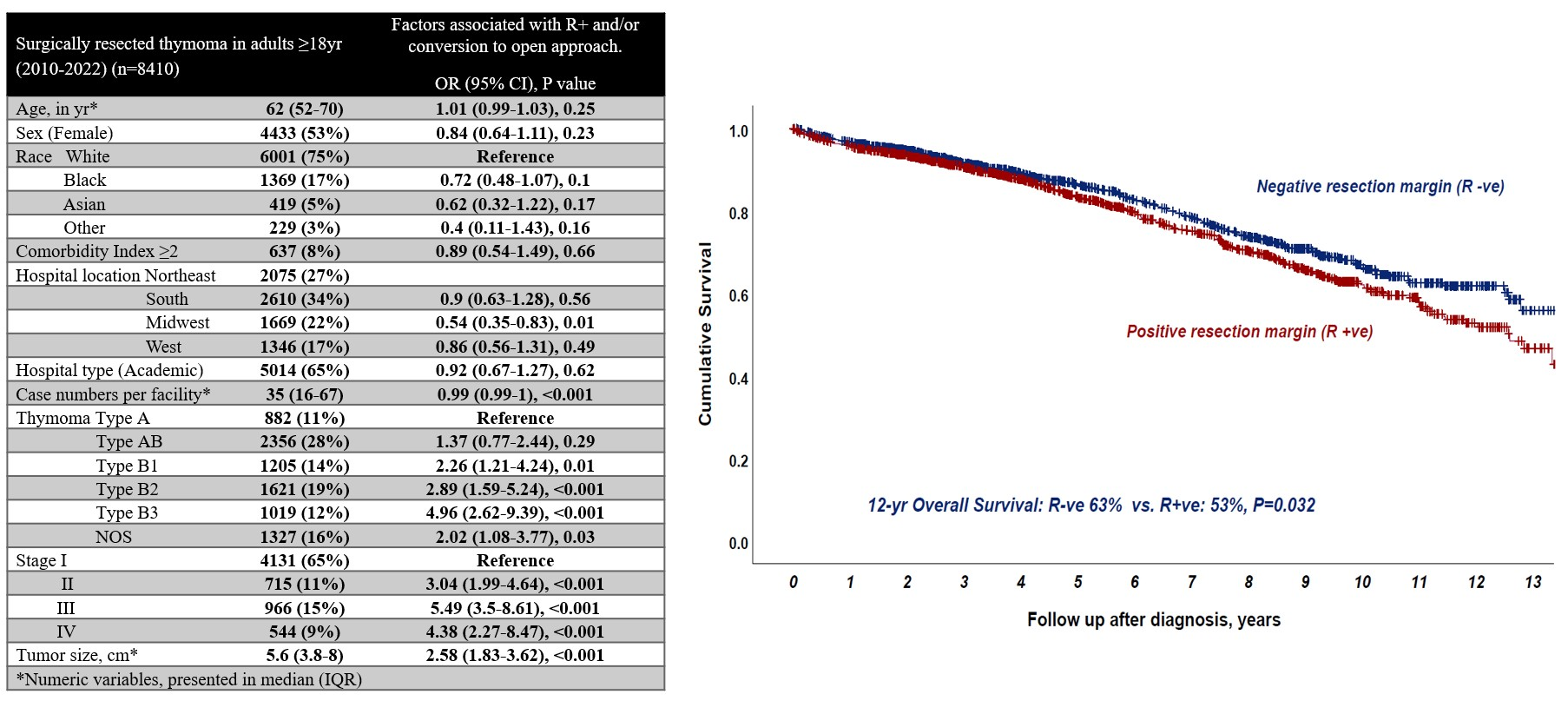
8,410 patients were analyzed (Table). MIS was performed in 47% (n=3,577), of them robotic approach was used in 70% and VATS was used in 30%. Conversion to an open approach was noted in 5% (n=178) and was associated with a higher 90-day mortality (4% vs. 1%, P<0.001). Positive resection margin (R+) was noted in 17% (n=616). In a propensity-matched analysis comparing patients with positive versus negative resection margins (n=1,281 per group; covariates: age, sex, comorbidity, thymoma subtype, and stage), the R+ group had worse overall survival (12-year, 53% vs. 63%, P=0.032) (Figure), after excluding perioperative mortality. Among patients who underwent MIS with known margin status (n=3,364), 22% (n=739) experienced either an R+ and/or conversion to an open approach (composite outcome). Factors significantly associated with these adverse outcomes included larger tumor size, aggressive thymoma subtypes, advanced stage, and lower hospital case volume (Table). On ROC analysis, tumor size correlated with the composite outcome (area under the curve 0.61, P<0.001). The optimal cutoff tumor size was 3.8-cm based on Youden's J statistic (0.2), while a 7-cm tumor size cutoff corresponded to 80% specificity.
Conclusions:
This study highlights the negative impact of positive resection margins or conversion to an open approach on both short- and long-term outcomes in patients undergoing MIS. Nearly one-quarter of MIS patients nationally experienced these adverse outcomes. By identifying factors associated with increased risk, the findings of this study may help guide informed discussions with patients and multidisciplinary teams to determine the optimal treatment strategy.
Mohamed Hussein (1), Ryan Campagna (2), Paul Feingold (1), Michal Lada (2), Christian Peyre (1), Carolyn Jones (1), (1) University of Rochester Medical Center, Rochester, NY, (2) N/A, Rochester, NY
|