马上注册,阅读更多内容,享用更多功能!
您需要 登录 才可以下载或查看,没有账号?立即注册 
×
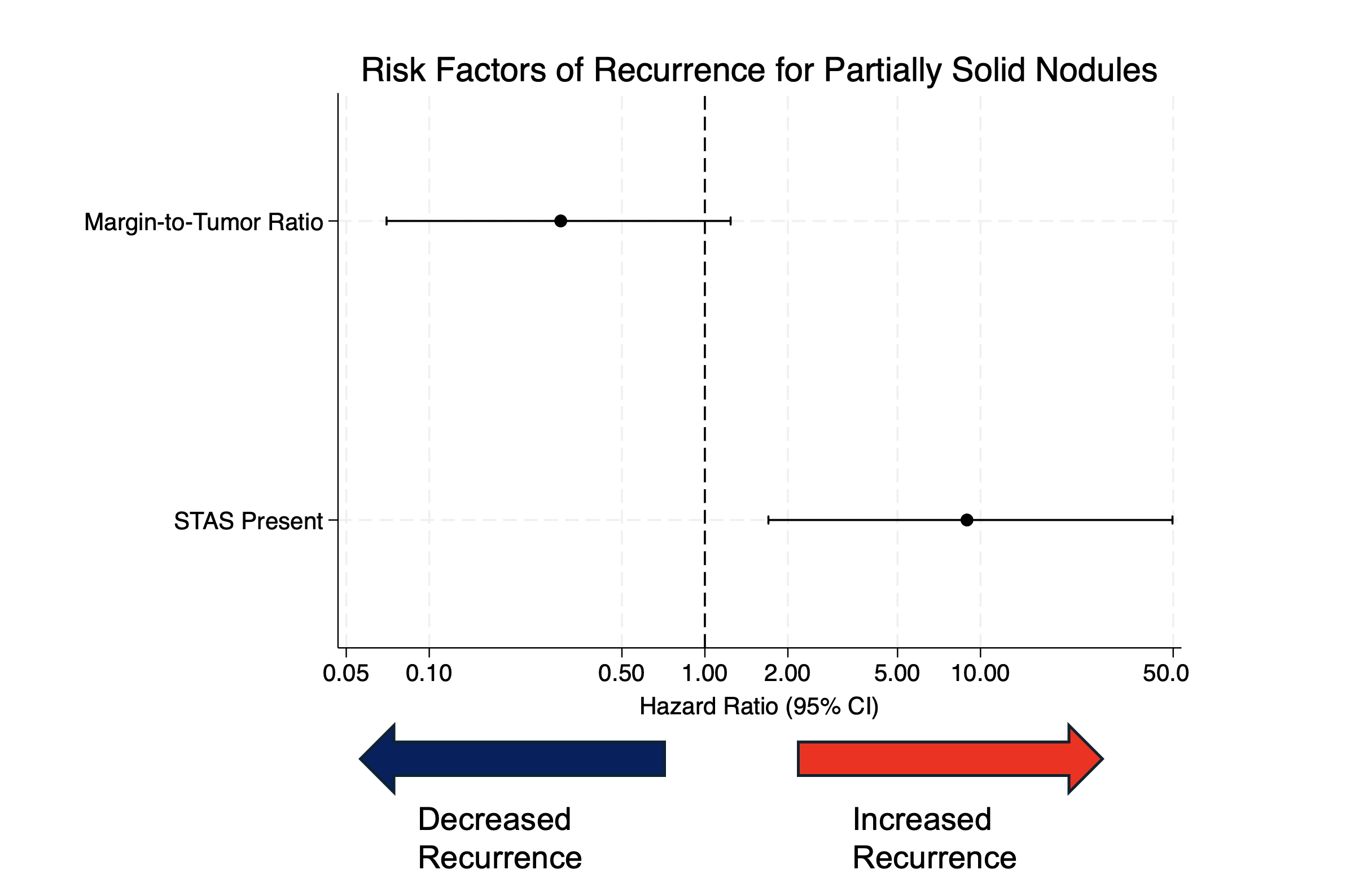
气腔播散(STAS)是影响部分实性肺结节术后复发的主要因素,独立于切缘距离和肿瘤大小。更远的切缘距离可能并不足于克服肿瘤的STAS生物学特性。
Beyond the Margin: Tumor Biology Trumps Technique in Part-Solid Lung Nodules
Background:
Predictors of recurrence following surgical resection of ground glass opacities (GGO) and part-solid nodules remain incompletely defined. We sought to identify clinicopathologic factors associated with recurrence in resected GGO and part-solid nodules in the modern era.
Methods:
Patients with GGO or part-solid nodules who underwent curative-intent resection between 2018–2023 from a single institution were retrospectively analyzed. Nodules were stratified by consolidation-to-tumor ratio (CTR), with GGOs defined as CTR=0 and part-solid nodules as 0< CTR <1. Clinicopathologic characteristics, including lymphovascular invasion (LVI), visceral pleural invasion (VPI), spread through air spaces (STAS), tumor size, and margin-to-tumor ratio (MTR) were compared between groups. Logistic regression was used to identify predictors of recurrence. To isolate the effect of tumor biology independent of technical factors, propensity score matching (PSM) was performed to control for tumor size and MTR.
Results:
A total of 229 patients were included (128 GGO, 101 part-solid). Part-solid nodules demonstrated larger median tumor size (2.17 vs 1.89 cm, p=0.039), higher pathologic T stage (p=0.008), and more frequent nodal upstaging (p=0.023). Despite these differences, overall recurrence rates were low and similar between cohorts (12.7% of GGO and 10.1% of part-solid patients, p=0.55). Among patients with part-solid nodules, recurrence was associated with a significantly higher prevalence of STAS compared with those without recurrence (44.4% vs 14.8%, p = 0.048), regardless of histology.
Although the overall prevalence of STAS did not differ between GGOs and part-solid nodules (26.0% vs 18.2%, p=0.165), its prognostic impact was confined to the part-solid cohort. On multivariable logistic regression, STAS was the strongest predictor of recurrence in part-solid nodules (aOR 13.1, 95% CI 1.99–106.4, p=0.01), and this association remained significant after propensity matching (aOR 8.9, 95% CI 1.7–49.7, p=0.009). Neither LVI, VPI, nor MTR independently predicted recurrence in the GGO cohort. Margin-to-tumor ratio did not significantly affect recurrence when STAS was absent.
Conclusions:
STAS is a dominant predictor of recurrence among resected part-solid nodules, independent of margin distance and tumor size. In these lesions, wider parenchymal margins may be insufficient to overcome adverse tumor biology. These findings support the need for intraoperative or pathologic STAS assessment to guide resection extent and postoperative surveillance intensity.
Vikram Krishna (1), Kellie Knabe (1), Philicia Moonsamy (1), Andrew Brownlee (1), Harmik Soukiasian (1), Raffaele Rocco (2), (1) Cedars-Sinai Medical Center, Los Angeles, CA, (2) Cedars Sinai Medical Center, Los Angeles, CA
|