马上注册,阅读更多内容,享用更多功能!
您需要 登录 才可以下载或查看,没有账号?立即注册 
×
新辅助化免治疗后最佳手术时机:多中心分析
Optimal Timing of Surgery After Neoadjuvant Chemoimmunotherapy in NSCLC: A Multi-Institution Analysis
Abstract Presenter:Tae Hee Hong, Department of Thoracic and Cardiovascular Surgery, Yonsei University College of Medicine
Objective:
The optimal timing of surgery after completing neoadjuvant chemoimmunotherapy (chemo-IO) remains uncertain. Delayed surgery may prolong immune-mediated tumor clearance, while excessive delay could lead to immune exhaustion or tumor repopulation. This study aimed to identify the optimal surgical timing after chemo-IO in resectable non-small cell lung cancer (NSCLC) and to determine whether the time-to-surgery (TTS) interval differentially influences pathologic outcomes across histologic subtypes.
Methods:
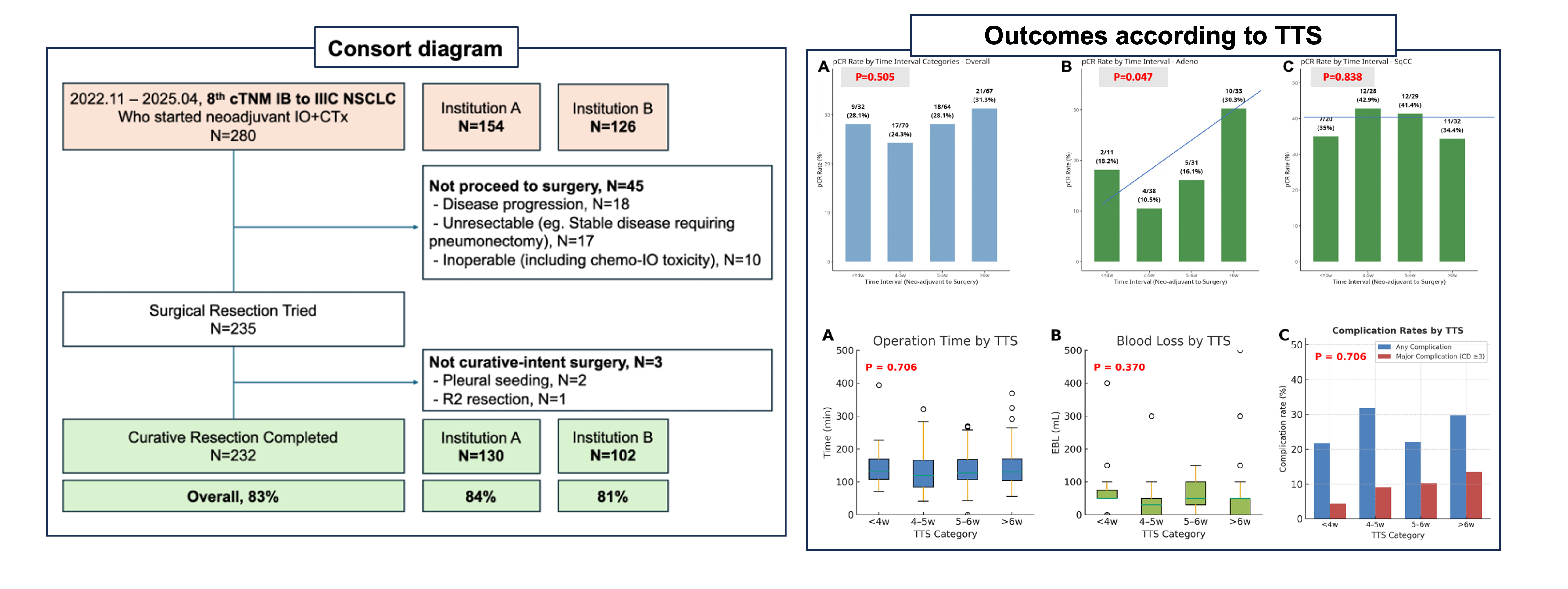
A dual-institution retrospective cohort study was conducted including 232 patients with clinical stage IB–III, EGFR/ALK wild-type NSCLC who underwent curative-intent pulmonary resection following chemo-IO between November 2022 and April 2025. TTS was defined as the interval from chemo-IO completion to surgery. Primary outcomes were pathologic complete response (pCR) and major pathologic response (MPR). Secondary outcomes included operative time, blood loss, and postoperative complications (grade ≥3). Time-trend analysis and Youden-index–based cutoff optimization were performed to identify histology-specific TTS thresholds associated with favorable pathologic outcomes.
Results:
Overall, pCR rates did not significantly differ across TTS intervals (p=0.505). In adenocarcinoma, delayed surgery beyond six weeks was associated with higher pCR rates (p=0.047), with the optimal cutoff identified at 6.5 weeks. In contrast, squamous cell carcinoma showed no significant trend (p=0.838), with an earlier cutoff at 4.5 weeks and no benefit from further delay. Surgical metrics - including operative time (p=0.706), estimated blood loss (p=0.370), and complication rates (p=0.706) - were comparable across all intervals, indicating no increase in procedural risk with delayed surgery.
Conclusions:
Within the recommended timing window, adenocarcinoma demonstrated improved pathologic responses with delayed surgery at 6–7 weeks, whereas squamous cell carcinoma maintained stable outcomes across all intervals, suggesting distinct immune kinetics by histology. Surgical morbidity was unaffected by timing, supporting the safety and practicality of a histology-tailored surgical strategy after chemo-IO. These findings highlight the clinical relevance of timing optimization after neoadjuvant immunotherapy and warrant prospective validation.
Tae Hee Hong (1), Yeong Jeong Jeon (2), Junghee Lee (2), Seong Yong Park (2), Jong Ho Cho (2), Yong Soo Choi (2), Sung Min Kim (1), Young Ho Yang (1), Ha Eun Kim (1), Byung Jo Park (1), Jin Gu Lee (1), DAE JOON KIM (1), Hong Kwan Kim (2), Chang Young Lee (1), (1) Department of Thoracic and Cardiovascular Surgery, Severance Hospital, Yonsei University, Seoul, Korea, Republic of, (2) Department of Thoracic and Cardiovascular Surgery, Samsung Medical Center, Sungkyunkwan University, Seoul, Korea, Republic of
|