马上注册,阅读更多内容,享用更多功能!
您需要 登录 才可以下载或查看,没有账号?立即注册 
×
Outcomes After Lung Resection in Patients with Marginal Pulmonary Function: Single Center Experience in 321 Patients
Objective:
To evaluate perioperative outcomes and long-term survival in patients with marginal pulmonary function undergoing resection for non-small cell lung cancer (NSCLC).
Methods:
A retrospective review was conducted of adult patients who underwent lung resection for NSCLC between January 2013 and December 2024 at a single high-volume center. Inclusion required preoperative predicted FEV₁ and/or DLCO ≤ 45%. Patients undergoing pneumonectomy, bilobectomy, or sleeve resection were excluded. Demographics, perioperative outcomes, and survival were assessed. Survival was estimated using Kaplan–Meier methods, and multivariable analysis used an accelerated failure time (Weibull) model adjusted for age, sex, lung function (FEV%, DLCO%), tumor location and stage. Survival estimates are reported as percent survival with 95% CIs for Kaplan–Meier analyses, and as time ratios (TR) with 95% CIs for multivariable results.
Results:
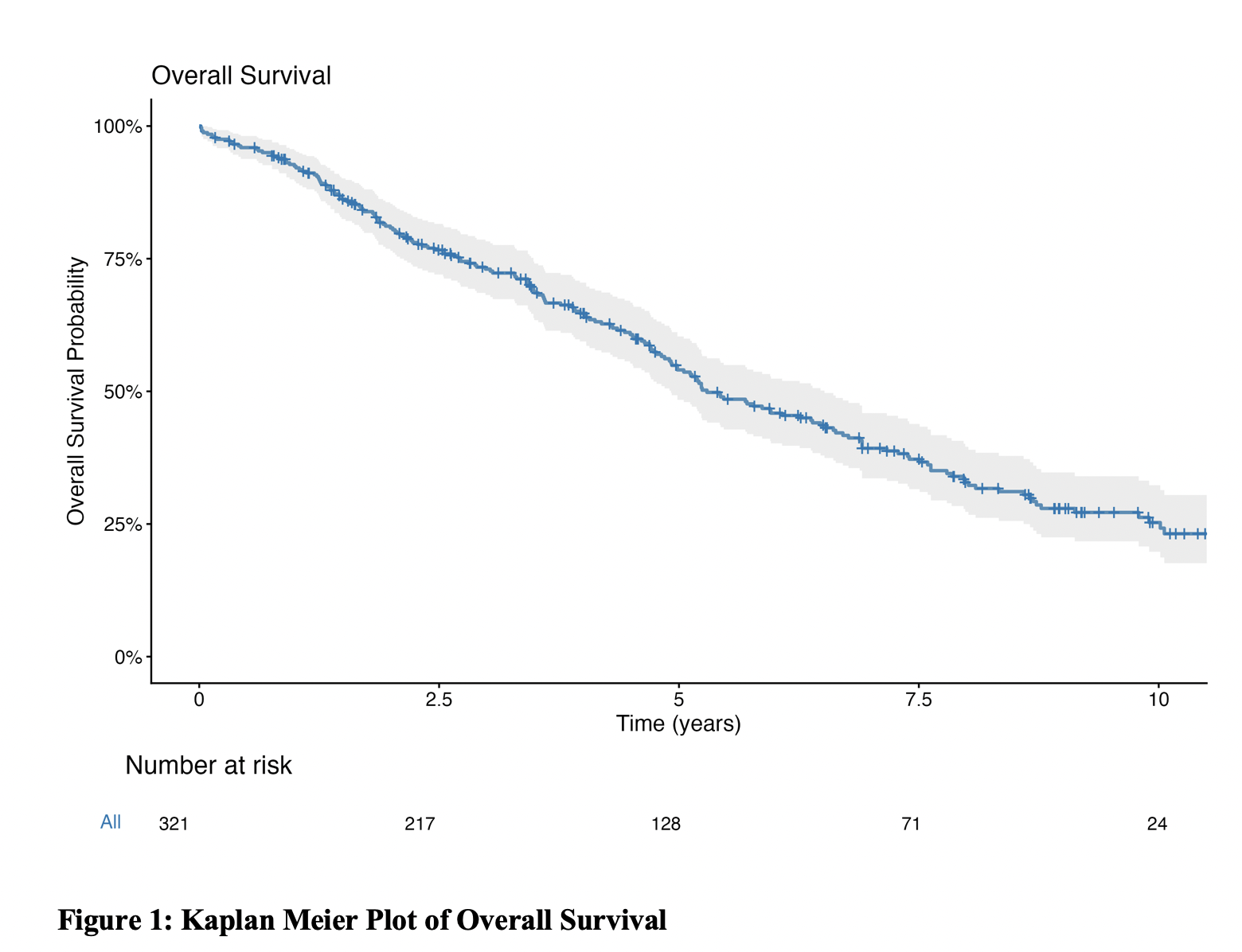
A total of 321 patients were identified (190 (59%) female, 131 (41%) male; median age 68 years). 231 patients had stage I disease (75%), 52 (16%) with stage II disease, and 28 (9%) with stage III. One hundred thirty-eight patients (43%) had FEV₁ ≤ 45% predicted, and 217 (68%) had DLCO ≤ 45% predicted. Surgical procedures included lobectomy (n=127, 40%), segmentectomy (n=68, 21%), and wedge resection (n=126, 39%). Perioperative mortality was 1.2%. The median length of stay was 5 days. Major postoperative events included respiratory failure (n=18, 6%), pneumonia (n=20, 6%), prolonged air leak (n=44, 14%), and atrial arrhythmia (n=35, 11%). One-year survival was 92% (90–95%), declining to 81% (76–85%) at two years and 54% (48–60%) at five years (Figure 1). In the multivariable analysis, wedge resection demonstrated a trend toward lower survival (TR 0.74 [0.54-1.0], p=0.05) relative to lobectomy. Higher age (TR 0.97 [0.95-0.98], p<0.001), male sex (TR 0.76 [0.58-0.99], p=0.04), and higher tumor stage (stage II: TR 0.66 [0.47-0.92], p=0.02; stage III: TR 0.64 [0.43-0.96], p=0.03) were independently associated with worse survival.
Conclusions:
In a high-volume center, lung resection for NSCLC can be performed safely in carefully selected patients with marginal pulmonary function, yielding low perioperative mortality and acceptable long-term survival. Patients undergoing wedge resection demonstrated a trend toward inferior survival, underscoring the need for careful patient selection when applying sublobar resection.
Ian Christie (1), Summer N Mazur (2), Marissa Matto (3), John Ryan (2), Arjun Pennathur (3), Matthew Schuchert (3), Ryan Levy (4), (1) N/A, Pittsburgh, PA, (2) University of Pittsburgh School of Medicine, Department of Cardiothoracic Surgery, Pittsburgh, PA, (3) University of Pittsburgh Medical Center, Pittsburgh, PA, (4) University of Pittsburgh School of Medicine, Pittsburgh, PA
|