马上注册,阅读更多内容,享用更多功能!
您需要 登录 才可以下载或查看,没有账号?立即注册 
×
Clinical Feasibility and Safety of Remote Robot-Assisted Lobectomy: A Pilot Study
Objective: To assess the feasibility and safety of performing remote lobectomy utilizing a surgical robotic system integrated with 5G mobile communication technology.
Methods: As part of an ongoing nationwide, prospective, multicenter trial (ChiCTR2400082241), adult patients with early-stage lung cancer requiring lobectomy were enrolled after providing written informed consent. Exclusion criteria included pregnancy or lactation, urgent surgical indication, uncorrected coagulopathy, or cardiopulmonary insufficiency` precluding lobectomy. Primary endpoints were technical success of surgery and incidence of postoperative complications graded by the Clavien-Dindo classification. In each case, surgeons operated remotely from Shanghai, while patients were hospitalized and underwent surgery at local centers. All procedures were performed utilizing the Toumai® endoscopic surgical robot system (MicroPort, Shanghai, China), with real-time signal transmission supported by China Telecom's dedicated 5G network.
Results: Between July and September 2024, six patients were enrolled and underwent radical lobectomy successfully, with no conversion to thoracotomy (Figure 1). Histopathology confirmed non-small cell lung cancer in all cases, with pathological staging consistent with preoperative assessment. The longest one-way transmission distance between surgeon side and patient side exceeded 5,000 km; the shortest was 230 km. No intraoperative interruptions or emergent events related to the robotic system occurred. A single voice transmission interruption was recorded in one case (P02), which resolved within one minute. The surgical signal transmission speed ranged from 69.4 to 72.6 Mbps, with a packet loss rate of 0.0096% to 0.0120% and latency between 25 and 151 ms. Two patients experienced minor postoperative complications: one developed an alveolopleural fistula (P01), and one had pneumonia (P04), both classified as Grade I–II. All patients had their chest tubes removed and were discharged within 3-5 days after surgery. There were no occurrences of blood transfusions, transfers to the intensive care unit, reoperations or readmissions within 30 days.
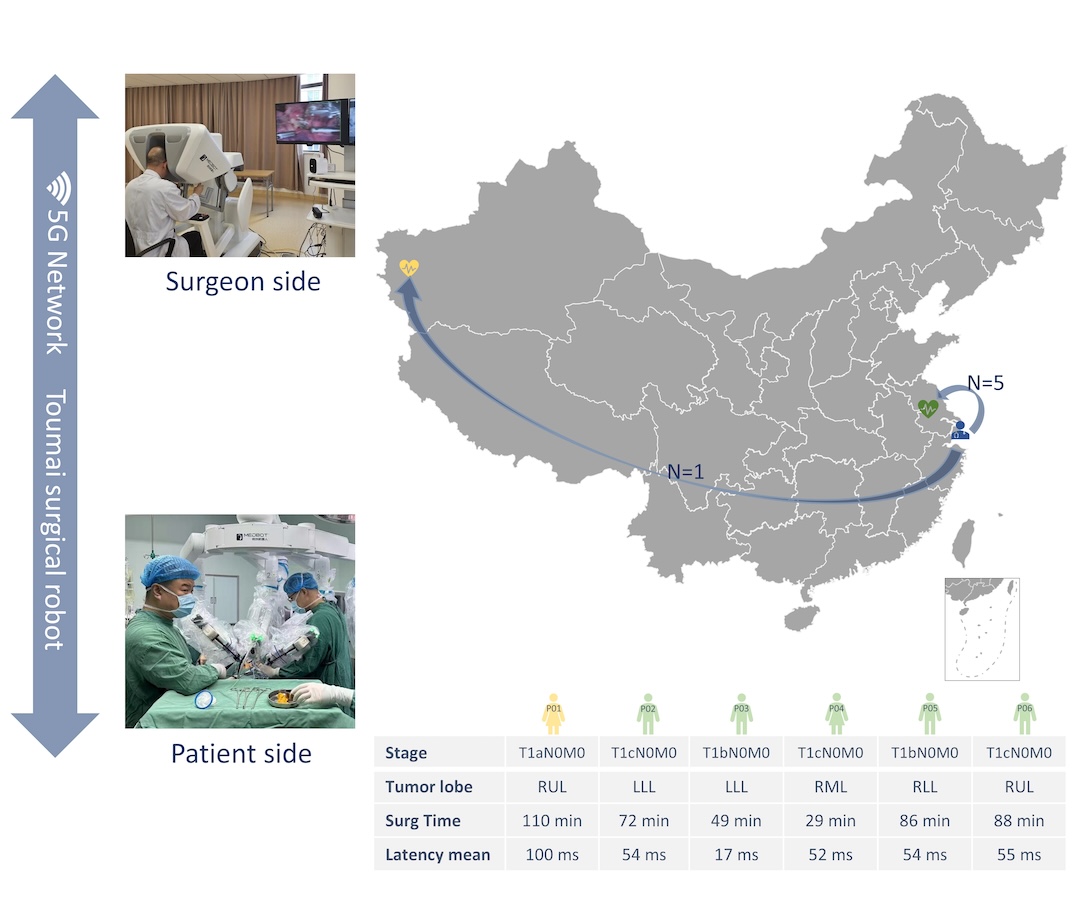
Conclusion: Preliminary findings suggest that remote robotic surgery, enabled by a reliable high-speed, low-latency mobile communication network, could be a feasible and safe approach for performing lobectomy. To draw more conclusive and generalizable results, further patient recruitment is warranted.
评论:
就目前而言,机器人辅助胸腔镜手术有一定的应用优势,但并不是所有的手术都有优势,尤其是在胸腔内,优势其实不多。但在泌尿外科,可能比较有优势。在胸腔手术,可能刚把机器摆好,VATS的手术可能都要做完了。
至于远程手术就更加有问题,仅是特殊情况下能够使用。
Yu Tian (1), Hanbo Pan (2), Jia Huang (3), Huibin Lv (4), Hong Guo (5), Qingquan Luo (6), (1) Shanghai Chest Hospital Affiliated to Shanghai Jiaotong University, Shanghai, Shanghai, (2) Shanghai Chest Hospital Affiliated to Shanghai Jiaotong University, Shanghai City, Shanghai, (3) N/A, Xu Hui District, China, (4) Department of Cardiothoracic Surgery, Kashi Prefecture Second People's Hospital, Kashi Prefecture, NA, (5) Affiliated Hospital of Yangzhou University, Yangzhou, NA, (6) Shanghai Chest Hospital, Shanghai, Shanghai
|