马上注册,阅读更多内容,享用更多功能!
您需要 登录 才可以下载或查看,没有账号?立即注册 
×
Surgical and Pathologic Prognostic Factors Affecting Recurrence and Survival after Neoadjuvant Chemoimmunotherapy and Resection for NSCLC – An International Collaborative Study
国际协作研究:新辅助化免治疗术后手术和病理预后因素影响复发和生存
OBJECTIVE: To determine surgical and pathologic variables associated with recurrence and survival following resection after neoadjuvant chemoimmunotherapy (chemo-IO).
METHODS: Data from six centers in the US, France and Germany were combined for patients undergoing resection after neoadjuvant checkpoint-inhibitor and chemotherapy for NSCLC. Recurrence was stratified by locoregional (± distant) or distant only, and compared by surgical approach, extent of resection, lymph node harvest, margin status, and pathology. The association of surgical and pathologic factors with recurrence-free (RFS) and overall survival (OS) was analyzed.
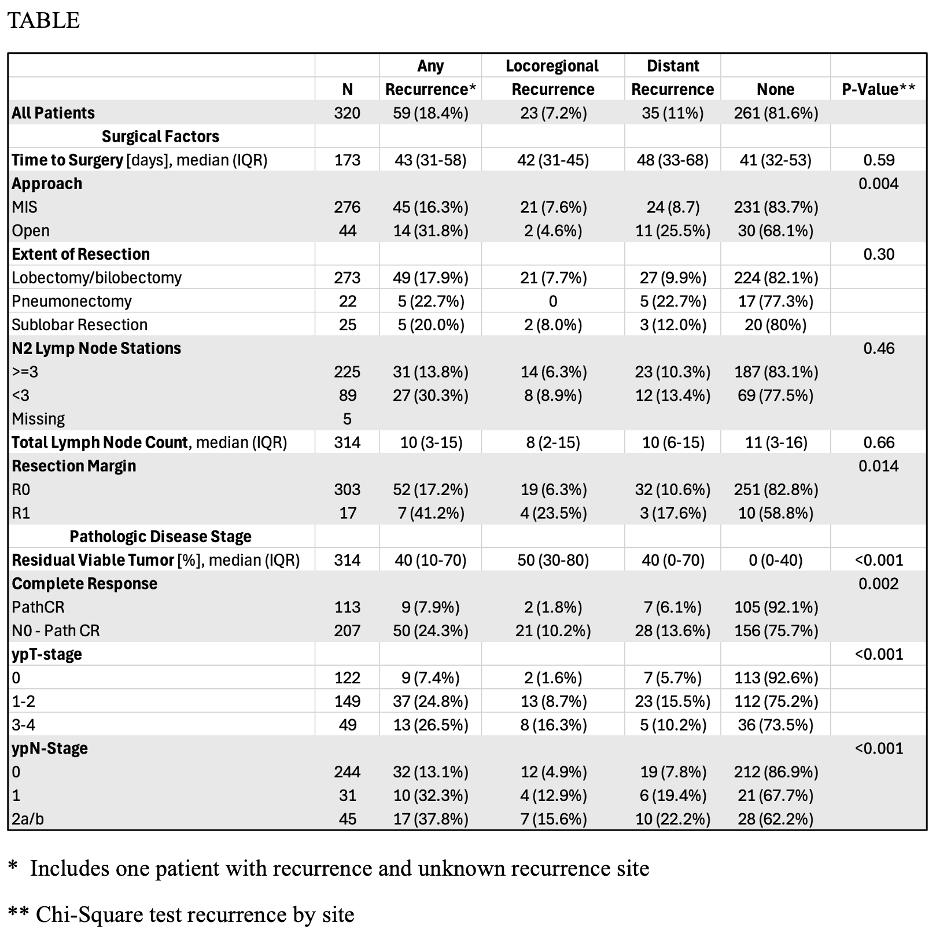
RESULTS: A total of 320 patients were included, with a median follow-up time of 16.4 months. Most patients underwent lobectomy (n=273, 85.3%), whereas 25 (7.8%) underwent sublobar resection and 22 (6.9%) required pneumonectomy. Minimally invasive surgery (MIS) was utilized for 276 (86.3%) patients, and open thoracotomy for 44 (13.8%) patients. A pathologic complete response (pCR) was more often observed in the MIS group (39.5% vs. 11.4% open, p=0.001). R0 resection was achieved in 303 (94.7%) patients. Recurrence was documented in 59 (18.4%) patients at a median time of 7.3 (IQR 3.4-13.4) months after surgery, which included 23 (7.2%) locoregional and 35 (11%) distant only disease sites. Recurrence rates were lowest in patients with a pCR (7.9%) and highest for patients with a positive margin (41.2% vs. R0 17.2%, p=0.013), or residual lymph node disease (35.5% vs. ypN0 13.1%, p=0.001). Open surgery was associated with higher recurrence rates (32.8% vs. MIS 18.4%, p=0.013), while procedure type and lymph node counts were not (Table). The 2-year estimated RFS after MIS was 77% (95%CI 70-85%) and 65% (95%CI 51-84%) after open surgery (p=0.013), and 2-year OS was 89% (95%CI 84-95%) vs. 63% (95%CI 48-83%, p<0.001), respectively. On multivariate analysis, MIS approach was no longer associated with RFS when adjusting for ypTNM-stage and adjuvant therapy, but remained independently associated with improved OS (HR 0.27, 95%CI 0.12-0.57, p<0.001).
CONCLUSIONS: In this multicenter analysis, minimally invasive resection after neoadjuvant chemoimmunotherapy was associated with a high rate of pathologic complete response and excellent overall survival. Recurrence was primarily driven by residual tumor and nodal disease, or positive margins rather than surgical factors.
Peter Kneuertz (1), Hadrien Maréchal (2), Nestor Villamizar (3), Nasser Altorki (4), Joseph Phillips (5), Philipp Schnorr (6), Dan Jones (4), Shane Scott (1), Theodore Dimitrov (1), Frankie Mbadinga (2), Desmond D'Souza (1), Ioana Baiu (1), Mahmoud Abdel-Rasoul (1), Joachim Schmidt (6), Dao Nguyen (3), Jean-Marc Baste (2), Robert Merritt (1), (1) The Ohio State University Wexner Medical Center, Columbus, OH, (2) Centre Hospitalier Universitaire de Rouen, Rouen, FR, (3) University of Miami School of Medicine, Miami, FL, (4) Weill Cornell Medicine/New York-Presbyterian Hospital, New York, NY, (5) Dartmouth-Hitchcock Medical Center, Lebanon, NH, (6) Helios Klinikum Bonn/Rhein-Sieg and University Hospital Bonn, Bonn, GER
|