|
Surgical Outcomes in Non Small Cell Lung Cancer with Distant Metastasis: The Prognostic Significance of Delayed Metastasis Diagnosis 远处转移的非小细胞肺癌患者的手术治疗结局:延迟诊断转移对预后的意义 Annals of Surgical Oncology IF 3.4 摘要要点 目的 本研究评估了在接受初始手术治疗的非小细胞肺癌(NSCLC)患者中,远处转移被延迟诊断对预后的影响,并将其结局与ⅢB期患者进行了比较。本研究同时鉴定了IV期NSCLC的独立预后因素。 方法 该研究招募了2010年6月至2017年12月期间接受肺叶切除术或肺切除术治疗的NSCLC患者,并在手术前评估了是否存在远处转移。比较IV期患者与未转移患者的总生存期(OS),并分析影响预后的因素。 结果
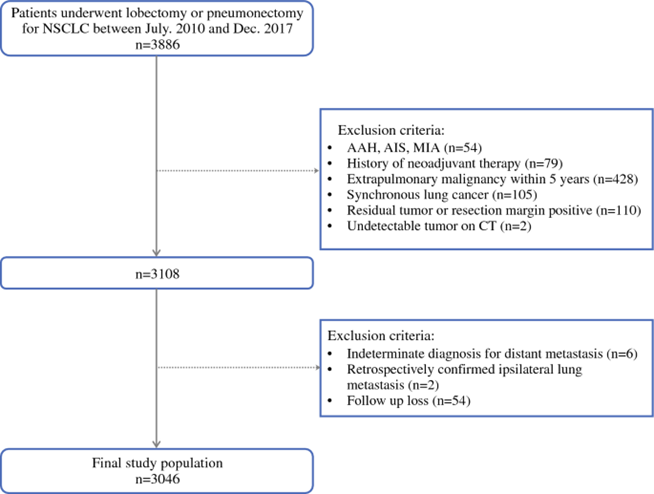
在3046例患者(平均年龄63岁; 1770例男性)中,100例(3.3%)发生了远处转移,术前诊断率为1.4%(42/3046),术后诊断率为1.9%(58/3046)。术后诊断的两个最常见转移部位是对侧肺(22/58,37.9%)和同侧胸膜(16/58,27.6%)。术后诊断为IV期NSCLC患者的OS(中位数,42.7个月)与IIIB期NSCLC患者相当(P = 0.865),而术前诊断为IV期NSCLC患者的OS(中位数,91.7个月)优于IIIB期NSCLC患者(P = 0.001)。在有远处转移的患者中,鳞癌(风险比[HR],3.15; P = 0.002)和远处转移的系统治疗(HR,2.42; P = 0.002)是OS恶化的独立预测因素。 结论
在接受初始手术治疗的NSCLC患者中,术后诊断为IV期NSCLC患者的OS与IIIB期NSCLC患者的OS相当。对于IV期NSCLC患者,鳞癌和全身转移治疗是OS较差的预后因素。
OBJIECTIVES This study evaluated the prognostic impact of delayed diagnosis of distant metastasis in non-small cell lung cancer (NSCLC) patients undergoing upfront surgery and compared their outcomes with stage IIIB patients. It also identified independent prognostic factors for stage IV disease. METHODS The study enrolled patients who underwent lobectomy or pneumonectomy for NSCLC between June 2010 and December 2017 and evaluated the presence of distant metastasis before surgery. Overall survival (OS) for patients with stage IV cancer was compared with that for patients without metastasis, and the prognostic factors were analyzed. RESULTS
Of 3046 patients (mean age, 63 years; 1770 men), 100 (3.3 %) had distant metastasis, diagnosed preoperatively in 1.4 % (42/3046) and postoperatively in 1.9 % (58/3046) of the patients. The two most common metastasis sites diagnosed after surgery were contralateral lung (22/58, 37.9 %) and ipsilateral pleura (16/58, 27.6 %). The OS (median, 42.7 months) for the patients with stage IV cancer diagnosed postoperatively was comparable with that for the patients with stage IIIB cancer (P = 0.865), whereas the OS (median OS, 91.7 months) for the patients with stage IV cancer diagnosed preoperatively was better than for the patients with stage IIIB cancer (P = 0.001). Among the patients with distant metastasis, squamous cell type (hazard ratio [HR], 3.15; P = 0.002) and systemic treatment for metastasis (HR, 2.42; P = 0.002) were independent predictors of worse OS. CONCLUSIONS Among NSCLC patients undergoing upfront surgery, the OS for the patients with stage IV cancer diagnosed postoperatively was comparable with that for the patients with stage IIIB cancer. For patients with stage IV disease, squamous cell type and systemic treatment for metastasis were prognostic factors for poorer OS.
DOI10.1245/s10434-024-14984-9 |